





Concrete driveway cost in the US typically runs from $2,695 to $7,998, with an average near $4,665, or roughly $8 to $18 per square foot, according to Thumbtack (updated April 2026). Size, slab thickness, finish, labor, and site condition move that price up or down, and replacing an old driveway costs more than a first-time install.
This guide covers average prices, cost examples, easy-to-miss expenses, and ways to build a realistic budget.
- Typical total: $2,695 to $7,998
- Typical rate: $8 to $18 per sq. ft.
- Source: Thumbtack, national data, updated April 9, 2026
How Much Does a Concrete Driveway Cost?
The national average cost to install a concrete driveway is about $4,665, according to Thumbtack. Most people pay between $2,695 and $7,998. These figures are for US homeowners, so your local quotes may land above or below them.
Price per square foot is a handy starting point, but it is not the whole story. A plain gray driveway costs less than a stamped or colored one, and a tricky site can add work that square footage alone will not show.
| Cost category | What to expect | Source |
| Average project cost | About $4,665 | Thumbtack, April 2026 |
| Typical project range | $2,695 to $7,998 | Thumbtack, April 2026 |
| Basic concrete | About $8 to $18 per sq. ft. for a standard installation | Thumbtack, April 2026 |
| Decorative concrete | Stamped finishes often run about $12 to $18 per sq. ft. | Fixr |
Larger driveways can exceed the typical national project range. The estimates above are based on driveway size and the selected per-square-foot rate, not a fixed maximum project price.
The decorative row comes from a different guide than the first three rows, so do not add the numbers together. The finish section later in this article explains that source.
Why Concrete Driveway Cost Estimates Differ
Two cost guides can give very different numbers for the same driveway. One may price plain concrete, while another includes decorative finishes or extra site work. For example, LawnStarter lists $6 to $16 per square foot, and Angi lists $8 to $20, both in 2026 guides.
This article uses Thumbtack for the basic installation price and keeps it consistent throughout. Thumbtack's figures cover installing a driveway, but they do not spell out demolition or permits, so treat those as extras and ask about them.
- National figures are budgeting guides, not contractor prices.
- Always ask whether a quote includes labor, base prep, removal, and disposal.
- Never average numbers from different guides. Their scopes do not match.
Concrete Driveway Cost by Size
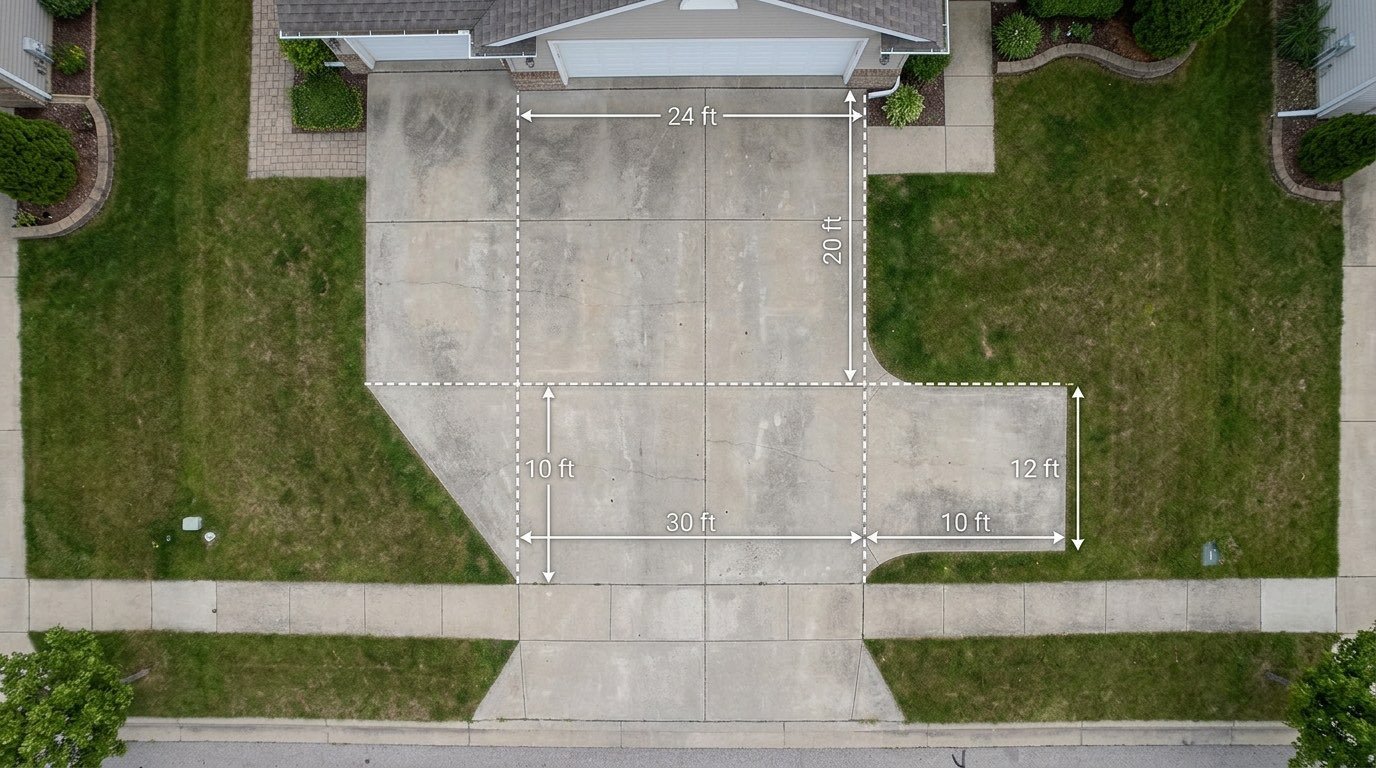
Size is the biggest driver of price, because a larger slab needs more concrete, more base material, and more labor. The table below shows common driveway dimensions. The cost column is my own calculation, multiplying each square footage by Thumbtack's $8 to $18 per square foot.
| Driveway size | Example dimensions | Square footage | Estimated cost |
| One-car driveway | 10 × 20 ft | 200 sq. ft. | $1,600 to $3,600 |
| Two-car driveway | 20 × 20 ft | 400 sq. ft. | $3,200 to $7,200 |
| Two-car driveway | 24 × 24 ft | 576 sq. ft. | $4,608 to $10,368 |
| Three-car driveway | 24 × 36 ft | 864 sq. ft. | $6,912 to $15,552 |
Larger driveways can exceed the typical national project range of $2,695 to $7,998. These estimates come from driveway size and the selected per-square-foot rate, not from a fixed maximum project price.
These are rough ranges before extras. The cost of a two-car concrete driveway at 576 square feet, for example, could land anywhere from about $4,600 to $10,400 depending on finish and site work.
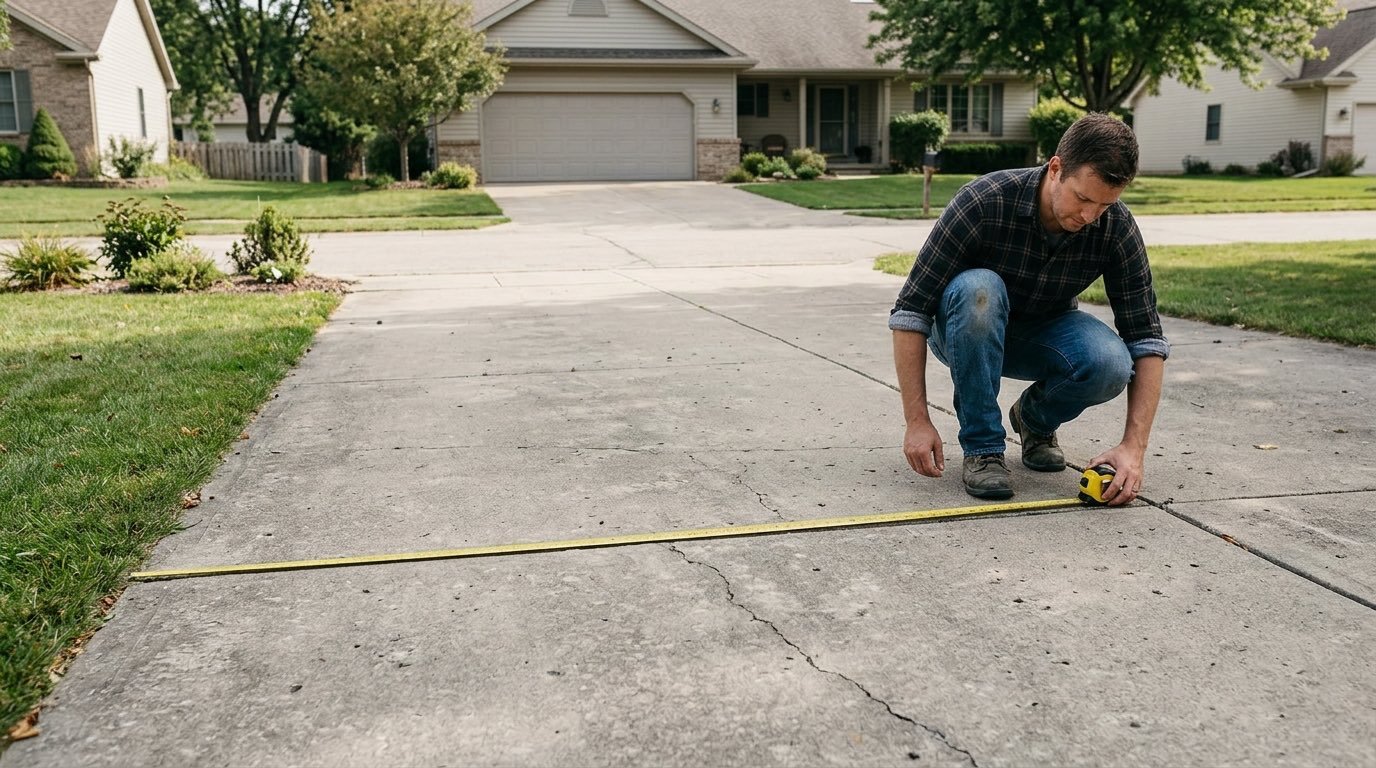
Irregular shapes need extra care. If your driveway curves, widens near the garage, or has a turnaround, split it into smaller rectangles, measure each one, and add them together.
How to Calculate Your Concrete Driveway Cost
You can build a quick estimate in a few minutes. Here is a simple concrete driveway cost calculator you can do by hand:
- Measure the length and width in feet.
- Multiply length × width to get square footage.
- Multiply that number by a concrete driveway cost per square foot, such as $8 to $18.
- Add extra costs like demolition, grading, and permits.
Example: A 20 × 20 ft driveway has 400 square feet. At a hypothetical rate of $10 per square foot, the starting estimate is $4,000, before extra project costs.
Concrete Driveway Cost by Finish and Design
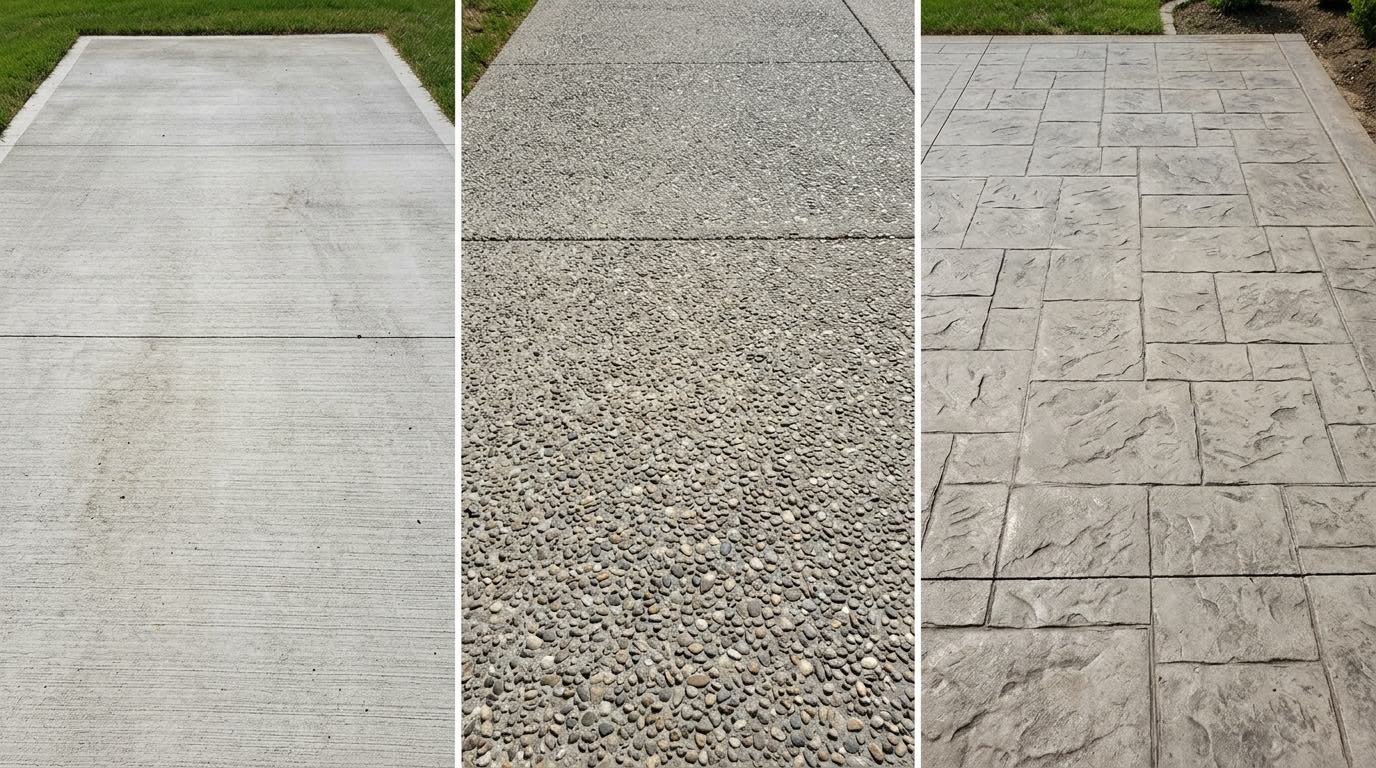
Plain gray concrete is the budget choice. Decorative options add color, texture, or patterns, and they usually cost more because they need extra materials, extra steps, and more skilled labor.
A note on sources: The table below uses Fixr's concrete driveway cost guide (page updated January 2025). These are national per-square-foot averages with labor included. Fixr and Thumbtack may use different project assumptions, so treat this table as a separate comparison of finishes, not a breakdown of the Thumbtack rate. That is why plain concrete here ($6 to $8) can sit below the $8 to $18 basic installation range earlier.
| Finish | What to know | Cost per sq. ft. |
| Plain gray concrete | Basic look with standard finishing | $6 to $8 |
| Broom finish | Lightly textured surface that helps with traction | $8 to $12 |
| Colored concrete | Color added to the mix or applied later | $8 to $12 |
| Exposed aggregate | Washed surface that shows the stones inside | $8 to $12 |
| Stamped concrete | Patterns made to look like stone or brick | $12 to $18 |
| Stained concrete | Color effects that may need touch-ups over time | $18 to $20 |
Stamped concrete driveway cost sits at the higher end because the work is slow and detailed. Labor makes up most of that price.
Some finishes only change how the driveway looks. Textured surfaces, like broom and exposed aggregate, can also give tires and shoes more grip. Smooth, polished surfaces can get slippery when wet, so ask your contractor which finish suits your climate.
Is Decorative Concrete Worth the Extra Cost?
Decorative concrete driveway cost is higher up front, so the real question is how much the look matters to you. A patterned or colored driveway can match your home's style in ways plain gray cannot.
However, decorative concrete is not automatically stronger than plain concrete. You are paying mostly for appearance.
Pros
- More design choices for color and pattern
- Can match your home's style and neighborhood
Cons
- Higher installation price
- May need sealing or touch-ups to keep its look
Before you decide, ask to see samples and photos of finished driveways. Also ask the contractor how often the surface needs sealing.
What Affects the Cost of a Concrete Driveway?
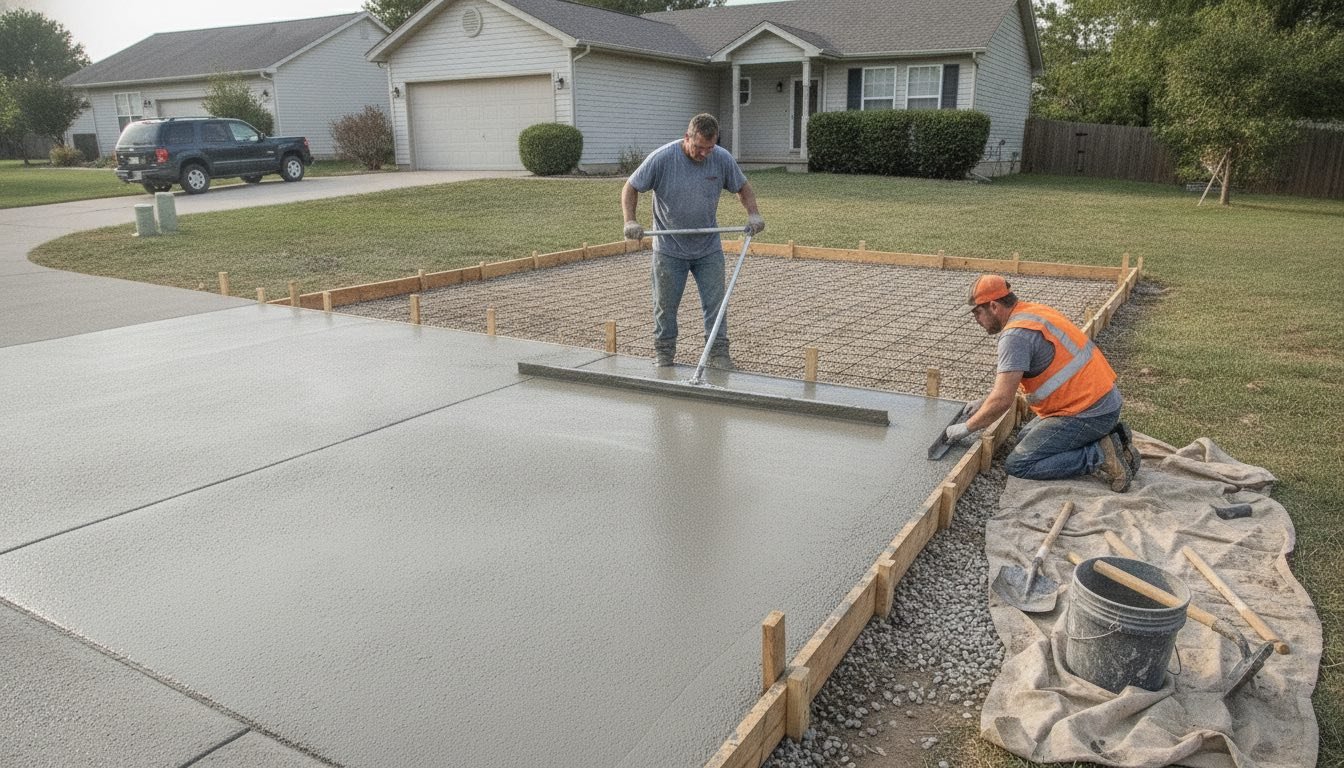
Concrete driveway installation cost changes from house to house because every site is different. Size, slab thickness, and the weight your driveway must carry all matter. So do the soil, the slope, and how much prep work the ground needs.
Local labor rates, material prices, delivery distance, and permit rules also play a part. Three of the biggest factors are covered below.
Driveway Thickness and Reinforcement
Concrete driveway thickness is one of the easiest ways to raise or lower a quote. A thicker slab needs more concrete. Many guides treat 4 inches as the minimum for regular cars, and some recommend 5 inches or more for heavy vehicles.
Reinforcement adds strength and helps hold cracks tight. Contractors commonly use rebar (steel bars) or wire mesh. Angi lists rebar at about $0.70 to $2.55 per linear foot, with an average near $1.40, not including labor.
| Situation | Common approach |
| Cars and light trucks | Around 4 inches, with reinforcement as the contractor advises |
| Heavy trucks, RVs, or equipment | A thicker slab and stronger reinforcement |
| Weak or wet soil | Extra base work and possibly added reinforcement |
Let your intended use and local conditions guide the final choice.
Site Preparation, Excavation, and Grading
Concrete driveway site preparation can change your estimate more than people expect. Concrete needs a stable, well-drained base. If the soil is soft or full of roots, the crew may need to dig it out and replace it.
Sloped or uneven lots often need extra grading, and tight access can slow down equipment. Poor prep can lead to settling, cracks, and puddles later.
Possible extra work includes:
- Excavating and hauling away unsuitable soil
- Adding and compacting a gravel base
- Regrading to fix slope or water flow
- Clearing trees, roots, or old fencing
- Working around tight access or utility lines
Labor, Materials, and Local Pricing
Concrete driveway labor cost covers more than pouring. Crews build forms, place reinforcement, spread and smooth the concrete, and finish the surface. Angi estimates that labor makes up about half of a typical project's cost.
Material prices also depend on where you live. Delivery distance, local supply, and how busy contractors are can all move the price.
- City projects may face higher labor rates and permit fees.
- Rural projects may add delivery or travel charges.
- Hard-to-reach driveways can need extra equipment or hand work.
Because of this, get several local quotes instead of leaning on national averages alone.
Additional Concrete Driveway Costs to Budget For
A quote for new concrete may not cover everything. Concrete driveway removal cost and concrete driveway replacement cost, for instance, show up only when an old slab is involved. The table below lists extras to ask about. Before you add any of them, check your quote so you do not pay for the same work twice.
| Additional expense | What to know |
| Existing driveway removal | Demolition, hauling, and disposal. Usually priced per sq. ft., so ask for a line item. |
| Permits and inspections | Rules and fees vary by city or county. Call your local building office. |
| Drainage improvements | Grading, drains, or other water control. Costs depend on your lot. |
| Driveway apron | Angi lists concrete aprons at about $3 to $10 per sq. ft. (no publication date shown on the page). |
| Sealing | LawnStarter lists concrete sealant at about $0.85 to $2.13 per sq. ft. (2026 guide). |
| Landscaping repairs | Fixing lawns or edges damaged by digging and equipment. |
Also plan where you will park for several days during pouring and curing.
New Installation vs. Driveway Replacement
Concrete driveway replacement cost runs higher than a new install because the old slab must be broken up, hauled away, and disposed of first. Crews may also need to fix the base underneath.
Resurfacing is cheaper, with LawnStarter listing concrete resurfacing at about $3 to $6 per square foot depending on thickness (2026 guide). But it only works when the slab underneath is still sound. Deep cracks, sinking, or drainage problems usually mean full replacement.
| Project type | Main cost considerations |
| New installation | Site prep, concrete, labor, and finishing |
| Full replacement | New installation costs plus demolition and disposal |
| Resurfacing | Condition of the existing slab and whether it can hold a new layer |
Concrete Driveway Cost Examples
The examples below show how a concrete driveway cost estimate comes together. They are hypothetical, not contractor quotes. Each one uses a round $10 per square foot installation rate, which sits inside Thumbtack's national range.
| Example | Project | Calculation | Estimated total |
| Small driveway | 200 sq. ft. | 200 × $10 | $2,000 |
| Two-car driveway | 400 to 576 sq. ft. | 400 × $10 to 576 × $10 | $4,000 to $5,760 |
| Replacement project | 400 sq. ft. existing driveway plus new concrete | (400 × $10) + (400 × $3 hypothetical removal) | $5,200 |
The $3 per square foot removal charge is a hypothetical number used only to show the math. Actual demolition and disposal charges depend on the thickness and condition of the existing slab, how easy it is to reach, and local contractor rates. Totals leave out permits, drainage work, sealing, and landscaping repairs.
How to Save Money on a Concrete Driveway
Concrete driveway installation cost can be managed without cutting corners. The goal is to spend on what matters and skip what does not.
- Compare at least three itemized estimates.
- Choose a simple finish if looks are not a priority.
- Settle the size and layout before work starts, since changes mid-project cost more.
- Ask whether your site allows any prep work to be simplified.
- Avoid extra thickness or fancy upgrades you do not need, while still meeting your use and local requirements.
- Ask if your contractor offers lower prices during a slower season.
- Do not skip site prep, drainage, or proper curing. Those shortcuts often lead to repairs later.
How to Choose a Concrete Driveway Contractor
A good concrete driveway contractor is worth more than the lowest bid. Compare itemized estimates side by side so you can see exactly what each price includes. A low total may leave out prep, reinforcement, or cleanup.
Use this checklist:
- Confirm licensing and insurance where your area requires them.
- Review recent projects and call a few references.
- Get a written scope, payment terms, warranty details, and a timeline.
- Ask about site preparation, reinforcement, concrete thickness, drainage, and curing.
- Confirm who pulls permits and whether inspections are needed.
- Check that the quote clearly lists removal and disposal if you are replacing a driveway.
Conclusion
Concrete driveway cost depends on size, finish, thickness, site preparation, and local labor rates.
Published price ranges, such as Thumbtack's $8 to $18 per square foot, are starting points rather than guaranteed quotes.
Measure your driveway, run a simple estimate, and then collect itemized quotes from qualified local contractors.
Before you sign, confirm what each quote includes, especially removal, base work, drainage, and permits. That one step can save you from surprise charges later.
Frequently Asked Questions
How long does a concrete driveway last?
With proper care, NerdWallet says a concrete driveway can last 30 to 40 years. Installation quality, drainage, climate, vehicle weight, and upkeep all affect that number. Even a well-built driveway can crack or wear over time, so think of this as a realistic target rather than a promise.
When can you drive on a newly poured concrete driveway?
Concrete needs time to gain strength. Concrete Network says concrete usually holds a car after about 7 to 10 days, but RVs and large trucks should wait at least 28 days. Your contractor's advice comes first, since mix, weather, and thickness all change the timing.
Does a concrete driveway increase home value?
A clean, well-kept driveway can improve curb appeal and make a home feel more cared for to buyers. Still, the effect on resale value depends on your local market and the rest of the property. No one can promise a specific return, so base your decision on how you will use the driveway.
Is a concrete driveway cheaper than an asphalt driveway?
Not usually at first. NerdWallet puts new asphalt at about $7 to $13 per square foot, while Thumbtack lists concrete at $8 to $18. These come from different guides, so use them as a rough comparison only. Concrete may last longer, and asphalt often needs periodic resealing. Climate, installation quality, and upkeep decide which costs less over time.
What time of year is best for installing a concrete driveway?
Mild, dry weather is usually best. Freezing temperatures can damage fresh concrete, heat can make it dry too fast, and heavy rain can mar the surface. Contractors can use protective methods in tougher conditions, so ask how they handle your local weather and how they will protect the slab as it cures.